Word Bridges Logic Connections
- 4.7
- Rating
- 100.00K
- Installs
- Free
- Price
 Analysis by App-foxy
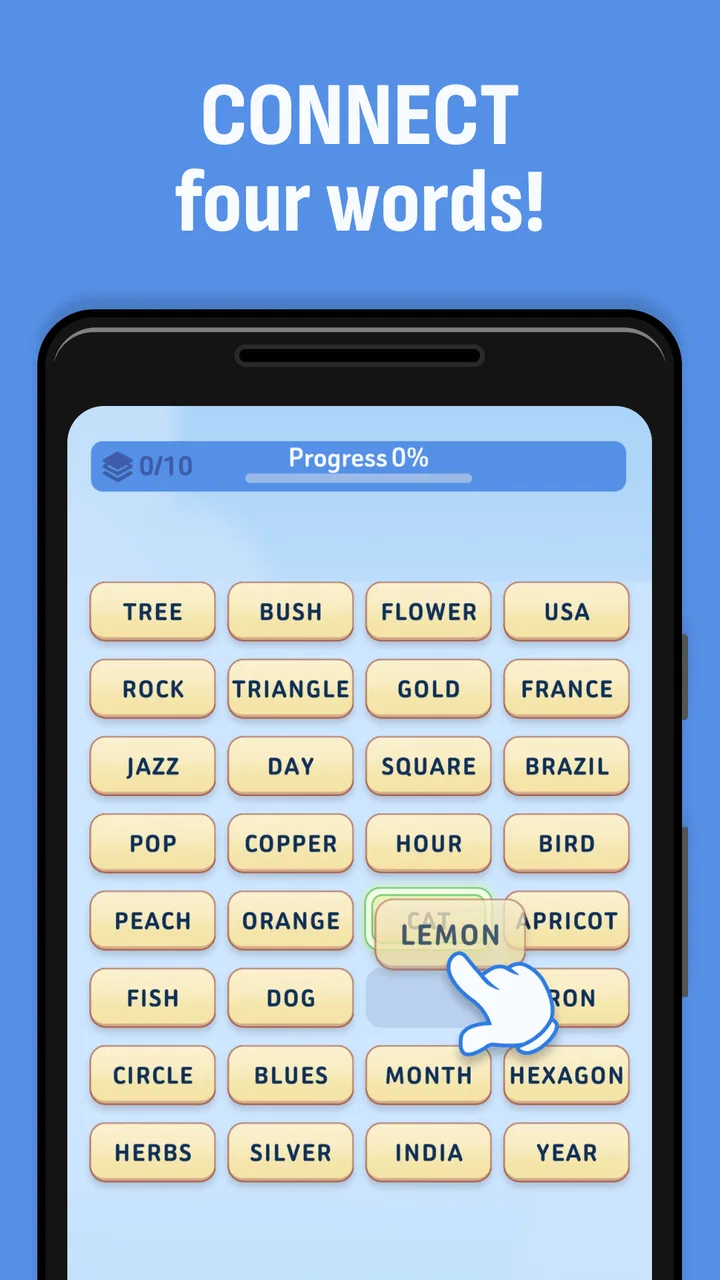
I approached Word Bridges Logic Connections as the kind of word game I could open without preparing for a long session. Its central idea is simple: connect words through meaning, then work out the relationship tying each group together. That sounds familiar at first, but the appeal comes from the small decisions between an obvious match and a tempting wrong one. I found myself reading every word more carefully than I expected, especially when two possible connections seemed equally convincing.
This is a free word puzzle from HYPERCELL, rated for Everyone and available for devices running Android 8.0 or later. It has reached over 100 thousand installs and holds a 4.7 average from around 18 thousand ratings, which gives it a reassuring level of visibility without making it feel like a noisy, competitive platform. The game is currently at version 1.4.2, and its offline play is particularly useful when I want a quiet distraction rather than another app that depends on a constant connection.
How I Decided Whether It Was Worth Keeping
For me, the first question with a word puzzle is not whether it is clever. It is whether the puzzle feels fair. A difficult board can be satisfying when the intended relationship becomes clear afterward, but it becomes tiring when the answer depends on an obscure interpretation or on guessing what the creator had in mind. Word Bridges Logic Connections works best when I can explain the completed group in a short sentence. That moment of recognition is what makes me want to try another board.
You May Also Like

 Blood Strike: 2.5 Anniversary
Blood Strike’s Loadouts Turn Every Drop Into a Tactical Gamble
A close look at Blood Strike’s custom loadouts: how fast access to signature weapons reshapes its battle royale rhythm, rewards preparation, and narrows the gap between fights.

 Pandora - Music & Podcasts
Pandora’s Music Is Easy to Start, but Harder to Recover
Pandora’s strength is its low-effort path from a seed to a station. Its weak spot is how much confidence it asks you to place in connection, setup, and quiet recovery.

 8 Ball Pool
 Is Built on Rivalries, Rematches, and Routine
A close look at the rivalries, rematches, shared routines, and unanswered safety questions that turn a quick pool match into a persistent mobile community.

 Samsung Music
’s Quiet Strength Is Playing What You Already Own
Its reach comes less from spectacle than from dependable access to a personal library. That simplicity is both the app’s strongest retention engine and its ceiling.

 AccuWeather: Weather Radar
AccuWeather Review: A Quick, Clear Forecast for Everyday Decisions
For everyday plans, the best forecast is the one you can understand quickly. AccuWeather makes rain timing, radar, and local conditions easy to act on, with a few trade-offs.

 Hill Climb Racing
Why Hill Climb Racing Still Turns Crashes Into One More Run
A tiny car, a bumpy hill and one more upgrade: Hill Climb Racing keeps resurfacing because its simple chaos makes every near-miss feel personal.
More From Our News Desk
View All News


The second decision point is the type of thinking involved. This is not a spelling drill, a traditional crossword, or a vocabulary game based mainly on definitions. I have to compare words against one another, test possible categories, and resist locking in the first connection that looks plausible. That makes it a good fit for someone who enjoys language, classification, and light deduction. It is less suitable if you want a fast game built around reflexes, visual effects, or a strong story.
I also pay attention to how easily a game fits into ordinary interruptions. Because the experience is designed around compact word challenges and can be played offline, I can use it during a short wait, on a commute with unreliable service, or at home when I want to step away from scrolling. I do not need to remember a complicated control scheme. The mental effort is in the board itself, not in learning how to operate the game.
The Useful Rhythm of a Board
My most effective approach is to scan the entire group before making a selection. I look for words that belong together in a very direct way, but I do not immediately commit if one of them could also support a broader category. The strongest-looking group is not always the best first move. Sometimes identifying a less obvious pair of related ideas helps remove a word that was making another category appear possible.
That is one of the more interesting habits the game encourages: I am not simply searching for synonyms. I am weighing relationships. A word may belong with others because of a shared subject, a familiar phrase, a use in everyday life, or a broader idea. The challenge is deciding which relationship is intended and which one is merely technically defensible. I found that writing down a mental reason for each proposed group reduced careless guesses.
When I get stuck, I avoid staring at the same four words indefinitely. I rebuild the board in my head by asking which words have the fewest possible homes. A highly specific-looking word can act as an anchor, while a common word may be deliberately placed to create a distraction. This is a practical tip that is easy to miss if you treat every tile as equally informative. The game becomes more manageable when I search for the most constrained word first.
Why the Offline Format Matters
Offline access changes how I use this particular game. I can start a puzzle in a place where I would not normally open a connected service, and I do not have to turn a brief break into a session of checking messages or browsing. That makes it a better companion for quiet moments than many word games that are built around online events, shared rankings, or regular network activity.
It also makes the game suitable for travel and backup entertainment. I would still check that the game is installed and ready before leaving a connection, but the ability to play without relying on live access is a meaningful strength. I like that the basic purpose remains intact when the phone is in a low-connectivity situation: I am there to solve word relationships, not to wait for a feed or a server response.
There is a trade-off, though. Offline play is excellent for independence, but it can make the experience feel more solitary if you prefer comparing results with other people. This is not the game I would choose when my main goal is social competition. I would choose it when I want the puzzle itself to be the activity.
Where It Wins Against Familiar Word-Game Choices
Compared with a crossword, Word Bridges Logic Connections asks less about filling a grid and more about seeing connections across a collection of words. I do not need to follow crossing letters or work through a sequence of clues. That makes the learning curve gentler for someone who likes language puzzles but finds traditional crossword structure too demanding or too dependent on specialist knowledge.
Compared with a word-search game, it offers more reasoning and less visual scanning. A word search rewards spotting hidden strings; this game rewards deciding why separate words belong together. If I want a calm activity that still requires me to form and test hypotheses, this is the stronger choice. If I want something almost meditative with minimal wrong turns, a word search may be more relaxing.
Compared with spelling-focused games, the emphasis here is not on producing a word from letters or racing to find the longest answer. That makes it friendlier to players who enjoy meaning more than speed. It also means that vocabulary knowledge alone does not guarantee an easy session. I need flexibility, because a familiar word can be used in an unexpected but reasonable relationship.
The game also has an advantage over many large puzzle apps that combine several unrelated modes. Its identity is clear. I know what kind of thinking I am opening it for, and that clarity makes it easier to use deliberately. I am less likely to spend time navigating menus when I only wanted a short mental break.
Small Frictions That Affect the Decision
The same focused design that makes the game approachable can limit its appeal. Players who need a strong sense of progression, a story, or a changing visual spectacle may find the format too restrained. The satisfaction comes from solving the connection, not from collecting elaborate rewards or exploring a larger world. I would not recommend it as a replacement for a full-featured adventure game.
Difficulty can also feel personal. A group that seems obvious to one player may be obscure to another because word associations depend on experience, interests, and familiarity with different expressions. When I miss a solution, I sometimes understand it immediately after seeing the relationship; at other times, the connection feels less natural. That variation is normal for this genre, but it means the game may be more enjoyable if you accept occasional ambiguity instead of expecting every puzzle to feel perfectly obvious.
Another consideration is the free-to-play model. The game costs nothing to download, while optional in-app purchases range from $0.99 to $17.99 per item. I would start with the free experience and decide later whether any purchase improves my routine. The important practical point is to treat purchases as optional support or convenience rather than assuming they are necessary for enjoying the core word-solving idea.
Because the content rating is Everyone, it is an easy recommendation for a broad household audience. Even so, younger players may need help with words or categories they have not encountered yet. I see that as a vocabulary difference rather than a problem with the rating. In a family setting, it could work well as a shared discussion game, with each person explaining why a group makes sense.
Everyday Situations Where It Fits
My favorite use case is a short pause between tasks. If I have several minutes before an appointment, I can open a board, inspect the words, and either solve it or leave it for later without needing to commit to a long campaign. The game gives that pause a little structure. Instead of automatically reaching for social media, I am making a small decision and testing my reasoning.
It also works during a quiet evening when I want something more active than watching a video but less demanding than learning a new skill. I can play while sitting with a drink, and the pace is controlled by how carefully I think. That flexibility is valuable: I can move quickly through an easy connection or slow down when the board contains misleading overlaps.
A useful group activity is to pass the phone around and ask each person to name the connection before confirming it. This turns the game into a conversation about language rather than a private test. The best discussions happen when two categories compete for the same word, because players have to explain not only what belongs together but why the alternative is weaker.
I would be more cautious about recommending it for someone who uses games mainly to relax after mental work. Word puzzles can be calming, but they still require concentration. If your ideal break means switching your brain off completely, a simple arcade game or a visual puzzle may serve you better.
What Switching From Another Category Involves
Moving from a crossword is fairly straightforward because both games reward patience and attention to wording, but the habits are different. Crossword players may initially look for individual answers, while this game asks them to delay certainty and compare the whole set. The adjustment is worthwhile if you enjoy discovering patterns, but it may feel uncomfortable if you prefer a clear clue-by-clue route.
Moving from a fast word game requires an even bigger change in pace. Speed is not the main source of satisfaction here. I get more from avoiding a plausible mistake than from answering instantly. That makes the game a good counterbalance to competitive word apps, although players who enjoy timers and pressure may miss that urgency.
There is little practical cost to trying it because the game is free, supports offline play, and has a broad age rating. The real cost is attention: I need to be willing to examine meanings instead of tapping randomly. If I switch to it expecting a passive distraction, I may leave disappointed. If I switch because I want compact reasoning exercises, the change feels natural.
I would skip it if my priority is a deep multiplayer system, a narrative campaign, or a game with constant novelty outside word relationships. I would also look elsewhere if I strongly dislike puzzles where an answer can depend on interpreting a category in a particular way. For those preferences, a more structured crossword, a spelling challenge, or a competitive word title may be a better match.
My Recommendation for Different Players
I recommend Word Bridges Logic Connections to anyone who likes sorting ideas, spotting semantic patterns, and solving a challenge at a comfortable pace. It is especially appealing if you want a word game that works in offline situations and does not require a large time commitment. The developer, HYPERCELL, has kept the concept focused enough that the game is easy to understand while still giving careful players room to develop a method.
My practical advice is to play slowly at first, identify the most specific words, and explain each proposed group before confirming it. That habit makes the experience more satisfying and helps separate a genuine connection from a lucky guess. If a board feels unfair, take a break and return with fresh eyes; forcing the same interpretation usually makes the misleading words seem even more convincing.
With its current version, 1.4.2, the game feels like a focused choice rather than an all-purpose puzzle collection. Its 4.7 average and substantial rating activity suggest that the central idea is resonating with many players, but my recommendation is still based on fit rather than popularity. The best reason to install it is the quality of its small reasoning moments: those times when a scattered set of words suddenly becomes a clear, explainable group.
In the end, I would keep it on my phone for short offline sessions, relaxed vocabulary practice, and occasional group play. I would not present it as the right game for everyone. It will not replace a crossword for grid enthusiasts or a competitive word game for speed-focused players. But if you want a free, approachable way to exercise association and classification without turning the activity into a race, Word Bridges Logic Connections is an easy one for me to recommend.
FAQs for Word Bridges Logic Connections
01What is Word Bridges Logic Connections and how does it work?
Word Bridges Logic Connections is a puzzle game designed to enhance your vocabulary and logic skills. Players are tasked with connecting words through logical associations to complete bridges. The game offers a variety of levels, each with increasing difficulty, providing a challenging yet rewarding experience for all ages.
02Is Word Bridges Logic Connections available on both Android and iOS?
Yes, Word Bridges Logic Connections is available for download on both Android and iOS platforms. Users can easily find the app on the Google Play Store and Apple App Store, ensuring accessibility to a wide audience. The app is optimized for smartphones and tablets, providing a seamless user experience.
03Are there any in-app purchases or ads in Word Bridges Logic Connections?
Word Bridges Logic Connections offers a free-to-play model with optional in-app purchases for users who wish to enhance their gaming experience. These purchases might include additional hints or unlocking new levels. The app also contains ads, but they are kept minimal to ensure a smooth and uninterrupted gameplay experience.
04What age group is Word Bridges Logic Connections suitable for?
Word Bridges Logic Connections is suitable for anyone aged 8 and above. The game’s content is family-friendly and designed to improve cognitive skills. Its intuitive interface and increasing difficulty levels make it engaging for both children and adults, fostering vocabulary growth and logical thinking.
05How can I track my progress in Word Bridges Logic Connections?
The app features a built-in progress tracker that allows players to see their achievements and levels completed. Additionally, users can sync their progress across devices by creating an account, ensuring that their game data is always up-to-date and accessible from any device.
Pros
- Engaging puzzles enhance critical thinking.
- User-friendly interface for all ages.
- Regular updates with new levels.
- Offline mode available for on-the-go play.
- Minimal ads
- non-intrusive experience.
Cons
- Limited hints can lead to frustration.
- Some levels feel repetitive.
- In-app purchases can be pricey.
- Occasional lag on older devices.
- No multiplayer mode available.

Word Bridges Logic Connections
Gallery